
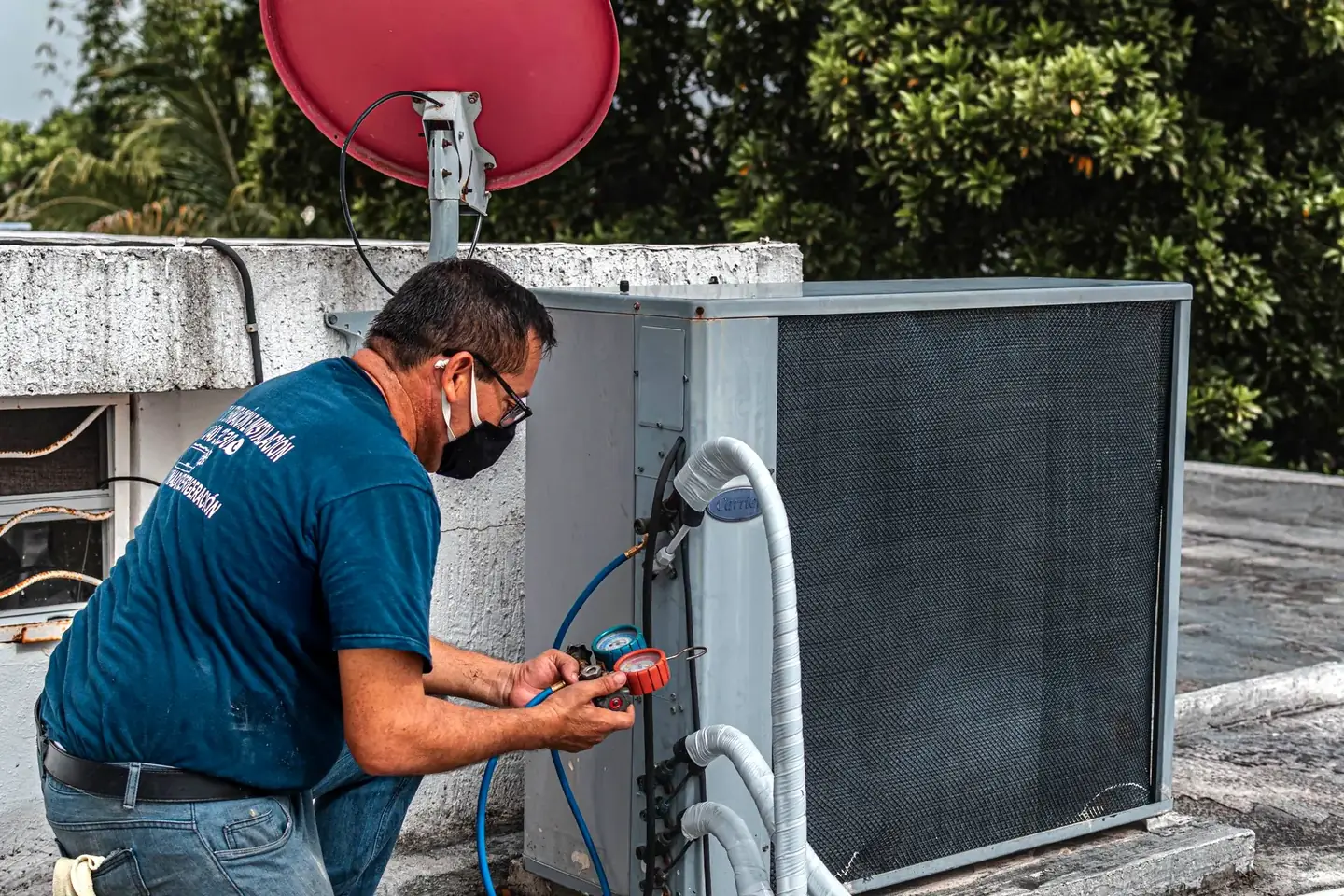
Heat Pump Repair & Installation in Rockwall, TX
One system that heats and cools — and a climate that suits it better than almost anywhere.
Heating & Air
Heat Pump Repair & Installation
A heat pump is an air conditioner that can run in reverse. In cooling it moves heat out of your house; in heating it moves heat from the outdoor air into your house — which is far more efficient than generating heat, because moving energy costs less than making it.
North Texas is close to an ideal climate for the technology. Our heating season is short and mild, and heat pumps operate at their best in exactly the temperature range we spend most of the winter in. The handful of genuinely cold days are handled by backup heat, and in a dual-fuel setup that backup is a gas furnace.
Heat pumps also fail in ways that are unfamiliar to people used to conventional systems, and get misdiagnosed as a result. Defrost cycles, reversing valves and auxiliary heat behavior all look alarming when they are working correctly.
When you need heat pumps
The symptoms homeowners actually describe when they call us — and what each one usually means.
It heats but never quite gets there
Heat pump supply air is cooler than furnace air — that is normal and not a fault. But a system that cannot maintain setpoint on a mild day has a real problem: low refrigerant, a failing reversing valve, or a defrost control issue.
Cooling works, heating does not (or vice versa)
Almost always the reversing valve or its solenoid. This is the component unique to heat pumps and the one most frequently misdiagnosed by technicians who do not work on them often.
The outdoor unit ices over and stays iced
Some frost during cold, damp weather is normal — the unit runs a defrost cycle to clear it. Ice that builds and never clears means the defrost control, sensor or board has failed, and running that way damages the system.
Auxiliary or emergency heat running constantly
Backup heat is meant for the coldest days and for defrost cycles. If it is running routinely, the heat pump is not doing its job — and electric backup heat is expensive to run. This one shows up on the bill before it shows up as discomfort.
Loud noises when it changes modes
A whoosh as the reversing valve shifts is normal. Banging, clanking or a sustained shriek is not.
Short cycling in either mode
Same causes as a conventional system — charge, airflow, controls, or oversizing — but on a heat pump it also degrades the efficiency advantage you paid for.
What actually happens on the job
No mystery, no vague diagnosis. Here is the sequence we follow every time.
Test in both modes
A heat pump has to be checked heating and cooling. A system that looks perfect in cooling can have a reversing valve fault that only appears in heat, and testing one mode is half a diagnosis.
Verify defrost operation
We force and observe a defrost cycle rather than assuming the control board is doing its job. Defrost faults are a leading cause of "my heat pump does not work in winter" calls.
Check the backup heat staging
Auxiliary heat should engage on a proper lockout and staging logic. Thermostats configured incorrectly for heat pump operation are extremely common, and the symptom is an electric bill nobody can explain.
Charge and airflow to specification
Heat pumps are less forgiving of charge errors than straight cooling systems because they have to perform in both directions. Weighed-in charge and verified airflow, not a gauge-and-guess.
The right technology for this climate — with two local caveats
Our climate profile suits heat pumps unusually well: a long cooling season where the equipment is doing the job any air conditioner would, and a short heating season spent mostly in the temperature range where heat pumps are most efficient. Two local caveats matter, though. First, our occasional hard freezes are severe enough that backup heat capacity has to be real, not nominal — the February 2021 event taught the whole region that lesson. A dual-fuel configuration with a gas furnace handles it best. Second, thermostat configuration is the single most common heat pump problem we find in this area. A conventional thermostat wired to a heat pump, or a heat pump thermostat with wrong staging settings, causes expensive auxiliary heat to run when the compressor should be doing the work — and homeowners blame the equipment for a settings problem.
Straight talk on pricing
Repairs vary by component. Defrost sensors and control boards are moderate; a reversing valve replacement is a significant repair because it involves refrigerant recovery and brazing. Installation cost is broadly comparable to a conventional system replacement, and dual-fuel adds the furnace side. Where heat pumps differ favorably is operating cost across our particular climate, and that is the number worth comparing over the years you plan to stay.
(469) 338-5533Heat Pumps questions we get asked
Why does my heat pump blow air that feels cool in heating mode?
Because it is. A heat pump delivers supply air at a lower temperature than a gas furnace does — comfortably above room temperature, but below body temperature, so it can feel cool against your hand. That is normal operation, not a fault. What matters is whether the house reaches and holds the setpoint. If it does, the system is working. This trips up nearly everyone switching from a furnace for the first time.
What is emergency heat and when should I use it?
Emergency heat bypasses the heat pump entirely and runs the backup heating element or furnace alone. It is intended for when the heat pump itself has failed, not as a "make it warmer faster" setting. Electric backup heat is expensive to run, so leaving the thermostat on emergency heat for a whole winter is a costly mistake. If you find yourself needing it regularly, something is wrong with the heat pump.
Is it normal for the outdoor unit to steam or ice up in winter?
Yes to both, within limits. Frost forms on the outdoor coil in cold, damp conditions, and the system periodically runs a defrost cycle — during which it may steam noticeably and briefly blow cool air indoors. That is designed behavior. Ice that accumulates and never clears, or a unit encased in ice, means the defrost system has failed and it should be looked at promptly.
Do heat pumps work in a Texas freeze?
They work well through the great majority of our winter, and capacity does fall as outdoor temperatures drop, which is exactly what backup heat is for. The practical answer for this region is a properly sized system with adequate backup — and for many homes that means dual-fuel, with a gas furnace taking over for the small number of genuinely severe days. Sized and configured correctly, comfort is not a compromise here.
What Rockwall neighbors say
"Fastest to respond and complete the job — a must when you wake up to no hot water on a cold morning. They cleaned my tankless water heater and had everything running perfectly."
"A great partner for both plumbing and HVAC. High-integrity company — responsive with questions, they show up on time, and their prices are reasonable. Exactly what you want."
"Fantastic. Great job for a fair price, responsive and professional the whole way through. Highly recommend Wilson Family for any plumbing work."
"Fair estimate and they went beyond to sort out the city requirements for us. Kari was incredibly responsive and Tyrone was professional and right on schedule."
Heat Pumps across Rockwall County & the Dallas metro
Same licensed team, same 24/7 phone, every one of these communities.
Related services
Worth reading first
Everything we do
Book Wilson Family — one call fixes plumbing, heating & air.
Upfront pricing, licensed technicians, and a family that treats your home like its own. We answer 24/7.